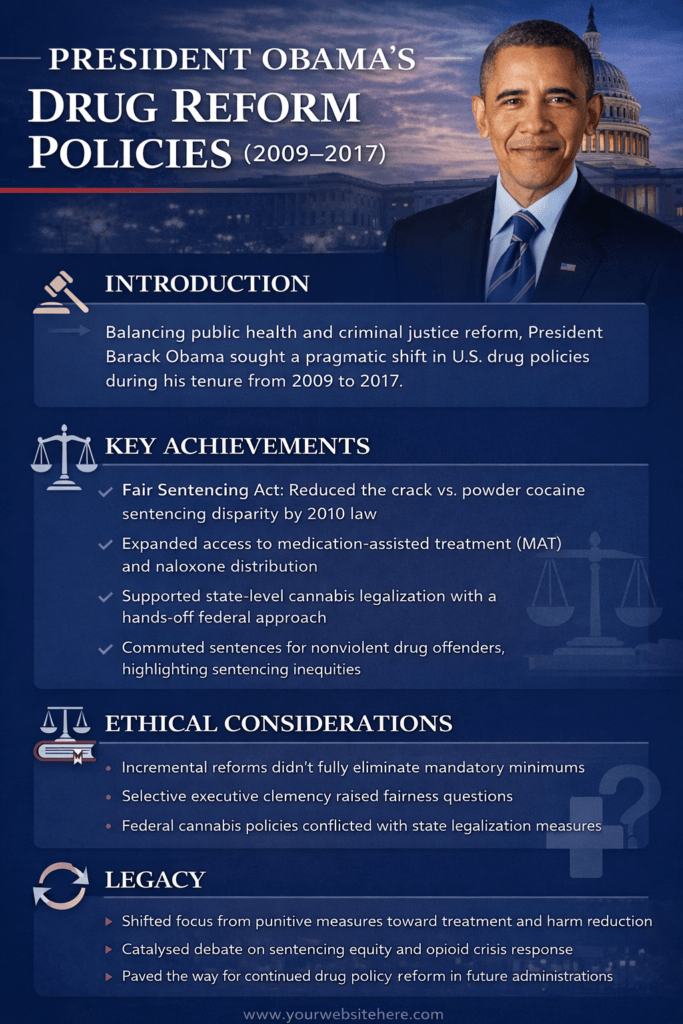
During Barack Obama’s presidency, U.S. drug policy moved toward a more balanced model that incorporated public health principles alongside traditional enforcement. A major step was the Fair Sentencing Act, which reduced sentencing disparities and acknowledged racial inequities in federal drug laws. At the same time, the administration expanded prevention initiatives, treatment access, and overdose-response efforts, reflecting a growing scientific understanding of addiction as a chronic medical condition. Overall, this period marked a gradual but meaningful shift toward evidence-based reform to improve fairness, treatment access, and long-term recovery outcomes.
Barack Obama and Drug Reform: Shifting Toward Public Health and Criminal Justice Reform
During his presidency from 2009 to 2017, Barack Obama advanced a drug reform approach that blended public health principles with measured criminal justice reform. Rather than dramatically dismantling the longstanding War on Drugs framework, his administration sought to rebalance it—expanding prevention and treatment while addressing disparities in sentencing and incarceration.
A defining moment of his drug policy was the passage of the Fair Sentencing Act in 2010. This legislation reduced the sentencing disparity between crack and powder cocaine offenses, a gap that had disproportionately affected Black communities for decades. By lowering mandatory minimum penalties for crack cocaine, the law marked a meaningful step toward correcting racial inequities in federal sentencing.
Obama’s administration also emphasized treatment and prevention. The White House Office of National Drug Control Policy increasingly framed substance use disorder as a chronic medical condition rather than solely a criminal issue. Federal funding expanded for medication-assisted treatment (MAT), mental health services, and community-based prevention programs. As the opioid crisis escalated, Obama supported broader naloxone distribution and issued executive actions aimed at improving prescribing practices and increasing access to addiction care.
At the same time, enforcement remained part of the national strategy. Federal law still classified cannabis as a Schedule I substance, though the administration adopted a more hands-off approach in states that legalized marijuana and complied with federal guidance. This signaled a shift toward state-level experimentation while maintaining federal oversight.
Obama also used executive clemency to commute the sentences of individuals serving long prison terms for nonviolent drug offenses. This effort highlighted concerns about mass incarceration and reflected growing bipartisan recognition that punitive drug policies had produced unintended social consequences.
Overall, President Obama’s drug reform policies represented a transitional era. His administration moved the national conversation toward evidence-based treatment, sentencing reform, and public health strategies—without fully abandoning enforcement structures. The result was a hybrid model: one foot in traditional drug control policy and the other stepping toward modern addiction science and criminal justice reform.
Advantages of Barack Obama’s Drug Reform Policies: Progress Toward Public Health and Fairness
During his presidency from 2009 to 2017, Barack Obama introduced reforms that reshaped national drug policy by balancing public health, criminal justice reform, and community safety. While enforcement remained part of federal strategy, several clear advantages emerged from his policy direction.
One major advantage was sentencing reform. The passage of the Fair Sentencing Act reduced the severe sentencing disparity between crack and powder cocaine offenses. This change helped address long-standing racial inequities in federal drug sentencing and reduced excessive prison terms for nonviolent offenders. By recalibrating mandatory minimums, the law contributed to a broader national conversation about fairness in the justice system.
Another advantage was the shift toward treating substance use disorder as a chronic medical condition rather than solely a criminal issue. During the Obama administration, federal agencies increased funding for prevention programs, behavioral health integration, and medication-assisted treatment. This public health framing aligned more closely with addiction science and reduced stigma by recognizing substance use disorder as a treatable illness.
Obama’s response to the growing opioid crisis also expanded access to naloxone distribution and promoted safer prescribing practices. These actions strengthened overdose prevention efforts and encouraged healthcare systems to adopt evidence-based approaches to pain management and addiction care.
Additionally, the administration supported executive clemency for individuals serving lengthy sentences for nonviolent drug offenses. These commutations not only provided relief to affected individuals and families but also signaled bipartisan openness to criminal justice reform.
Finally, the federal government’s more restrained approach toward state-level cannabis legalization allowed states to experiment with alternative regulatory frameworks without aggressive federal interference. This flexibility fostered policy innovation while maintaining national oversight.
Overall, the advantages of Obama’s drug reform policies include improved sentencing equity, expanded treatment access, strengthened overdose prevention, reduced stigma, and a gradual shift toward evidence-based public health strategies—laying groundwork for continued reform in subsequent administrations.
Disadvantages of Barack Obama’s Drug Reform Policies: Limits of Incremental Change
During his presidency (2009–2017), Barack Obama introduced reforms that shifted national drug policy toward treatment and sentencing equity. However, critics argue that several limitations and unintended consequences weakened the overall impact of these efforts.
One major disadvantage was that reforms were incremental rather than structural. While the Fair Sentencing Act reduced disparities between crack and powder cocaine sentencing, it did not fully eliminate mandatory minimum sentencing laws. Many individuals remained incarcerated under older, harsher policies, and broader federal drug statutes were largely unchanged.
Another criticism centers on the continued federal classification of cannabis as a Schedule I substance. Although the administration adopted a more hands-off approach toward states legalizing marijuana, federal law was not formally amended. This created ongoing legal ambiguity for businesses, patients, and financial institutions operating in states with legalization frameworks.
Funding and infrastructure gaps also limited progress. Despite increased emphasis on treatment and prevention, access to medication-assisted treatment and behavioral health services remained uneven—particularly in rural and underserved areas. As the opioid crisis intensified, some public health experts argued that the federal response did not expand quickly enough to meet rising overdose rates.
Additionally, enforcement efforts continued under existing War on Drugs structures. Federal prosecutions for certain drug offenses persisted, and immigration-related drug enforcement raised ethical concerns among advocacy groups. Critics argue that maintaining strong enforcement mechanisms alongside reform efforts sent mixed policy signals.
Finally, executive clemency initiatives—while impactful for those granted relief—affected only a small fraction of individuals serving lengthy drug sentences. Without a broader legislative overhaul, many systemic incarceration issues remained unresolved.
In summary, the disadvantages of Obama’s drug reform policies largely stem from their incremental scope. While progress was made in sentencing reform and public health framing, structural enforcement systems, legal inconsistencies, and treatment access disparities limited the depth and speed of national transformation.
Ethical Dilemmas in Barack Obama’s Drug Reform Policies
During his presidency (2009–2017), Barack Obama sought to rebalance U.S. drug policy by integrating public health principles with criminal justice reform. While these efforts reflected evolving addiction science and bipartisan reform movements, they also presented complex ethical dilemmas that remain relevant today.
One major ethical tension was between fairness and legal consistency. The passage of the Fair Sentencing Act reduced sentencing disparities between crack and powder cocaine, addressing racial inequities embedded in prior laws. However, the reform was not initially fully retroactive, meaning many individuals continued to serve lengthy sentences under older standards. This raised ethical questions about whether justice is delayed or denied.
Another dilemma concerned executive clemency. Obama commuted the sentences of numerous nonviolent drug offenders, aiming to correct excessive punishments. Yet clemency is inherently selective. Deciding who receives relief and who does not creates ethical challenges about transparency, equity, and the limits of executive authority in addressing systemic injustice.
The administration’s approach to cannabis policy also generated ethical complexity. While federal enforcement was relaxed in states that legalized marijuana, cannabis remained classified as a Schedule I substance under federal law. This dual system created uncertainty for patients, businesses, and healthcare providers—raising questions about fairness, federalism, and regulatory clarity.
The opioid crisis further intensified ethical debates. Expanding access to treatment and distributing naloxone in alignment with public health ethics, emphasizing harm reduction and saving lives. However, critics argued that federal action did not accelerate quickly enough as overdose deaths surged, prompting concerns about urgency, resource allocation, and governmental responsibility to protect vulnerable populations.
Finally, balancing enforcement with compassion posed an enduring moral challenge. Maintaining elements of the War on Drugs framework while promoting treatment-centered reform required navigating competing ethical priorities: public safety, personal liberty, rehabilitation, and systemic equity.
In summary, the ethical dilemmas of Obama’s drug reform policies stemmed not from inaction but from the need to navigate a transitional era. His administration worked to humanize drug policy while operating within entrenched legal systems—highlighting the moral complexity of reforming national addiction policy in a divided political landscape.
Frequently Asked Questions
Here are some common questions:
1. What was President Obama’s overall approach to drug policy?
President Obama promoted a balanced strategy that combined criminal justice reform with public health principles. His administration emphasized prevention, treatment, and sentencing reform while maintaining certain enforcement structures within the broader War on Drugs framework.
2. What was the Fair Sentencing Act, and why was it important?
The Fair Sentencing Act reduced the federal sentencing disparity between crack and powder cocaine offenses. It addressed long-standing racial inequities in sentencing and lowered mandatory minimum penalties for many nonviolent drug offenses.
3. Did Obama eliminate mandatory minimum drug sentences?
No. While the administration supported reforms and reduced some disparities, mandatory minimum sentencing laws were not fully eliminated during his presidency.
4. How did his administration respond to the opioid crisis?
The Obama administration expanded access to medication-assisted treatment (MAT), supported wider naloxone distribution to reverse overdoses, and promoted safer opioid prescribing practices. These efforts marked a stronger public health response to addiction.
5. What was Obama’s stance on cannabis legalization?
Although cannabis remained federally classified as a Schedule I substance, the administration adopted a more hands-off enforcement approach in states that legalized marijuana and complied with federal guidance.
6. Did Obama grant clemency to drug offenders?
Yes. He used executive clemency to commute sentences for many individuals serving lengthy terms for nonviolent drug offenses, highlighting concerns about mass incarceration and sentencing inequities.
7. Were overdose deaths reduced during his presidency?
Despite policy efforts, opioid overdose deaths continued to rise during much of his tenure due to factors such as increased heroin use and the emergence of synthetic opioids like fentanyl.
8. What is considered the long-term impact of his drug reform policies?
Obama’s policies helped shift the national conversation toward treating substance use disorder as a chronic medical condition and laid the groundwork for future bipartisan criminal justice reforms and expanded harm reduction initiatives.
Conclusion
President Obama’s drug reform policies represented a pivotal moment in modern addiction policy. His administration advanced sentencing equity, expanded treatment access, and reframed substance use disorder as a chronic medical condition deserving of compassionate care. At the same time, structural enforcement mechanisms and federal drug classifications remained largely intact, reflecting the era’s political and institutional constraints. Ultimately, Obama’s drug reform legacy lies in shifting the national dialogue—from punishment-centered responses toward a more balanced model that integrated public health, criminal justice reform, and harm reduction principles.
Video: Obama’s Overlooked Legacy That Saved Lives #DrugReform #PublicHealth #OverdosePrevention